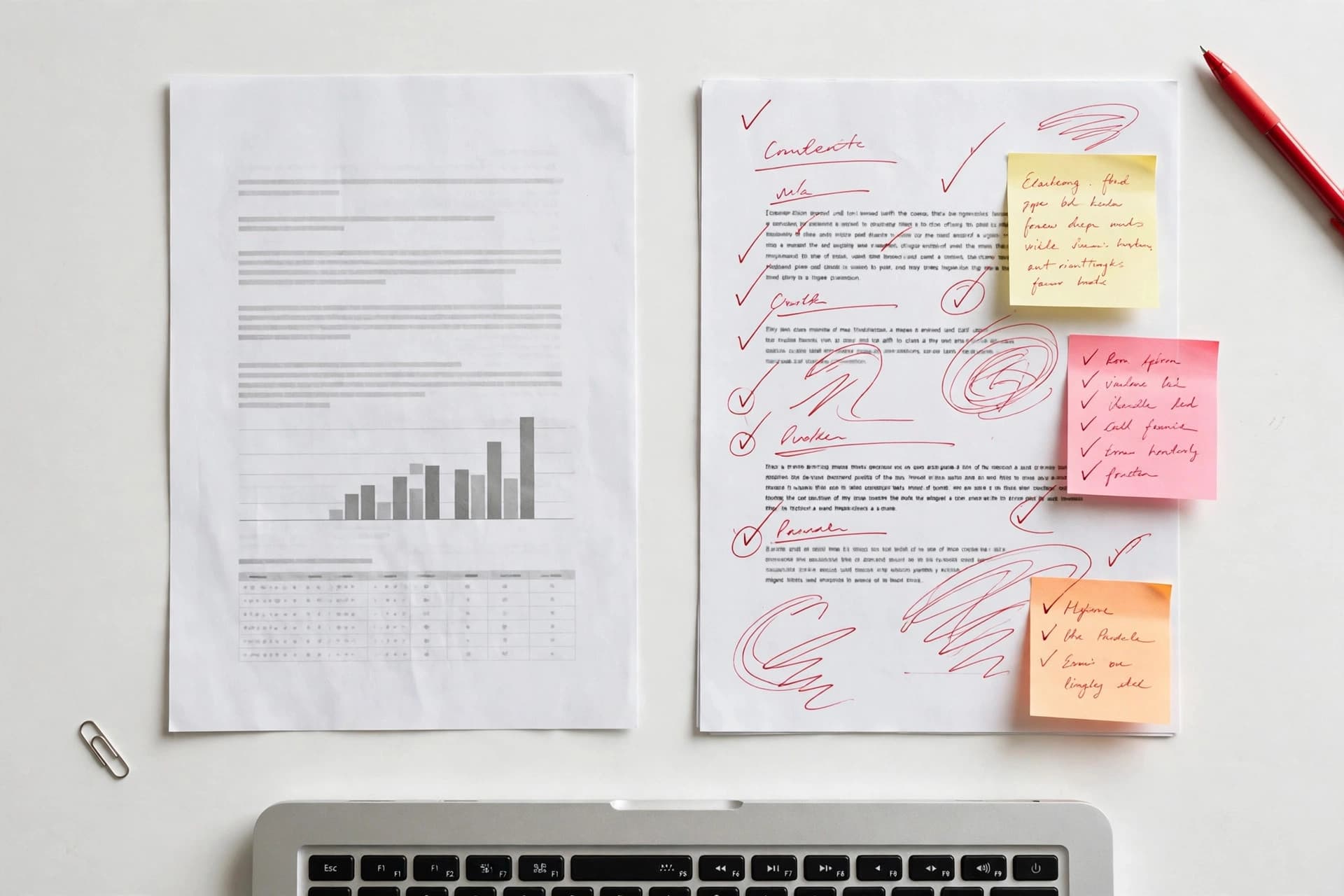
The short answer: use DOCX while a document is alive — being drafted, edited, or collaborated on — and PDF when it's finished and needs to look identical everywhere. That's the whole decision in one sentence. Everything below is just applying it.
The one-paragraph explainer
A Word document (DOCX) is a set of instructions: "here's the text, here are the styles, flow it to fit." Open it on a different computer with different fonts and it reflows — sometimes subtly, sometimes dramatically. A PDF is a snapshot: "put this exact letter at these exact coordinates." It looks the same on every device ever made. That single difference — reflowable vs. fixed — determines which format every document should live in.
Use Word (DOCX) when...
- The document is still being written. Drafts, manuscripts, reports in progress.
- Others will edit it. Tracked changes, comments, and collaborative editing are Word's home turf.
- It's a template. Forms, letterheads, and documents others will fill in and adapt.
- Content matters more than appearance. The words are the point; the layout can shift.
- It needs to reflow. Accessibility (screen readers handle DOCX well), translation workflows, and responsive reading all favor reflowable text.
Use PDF when...
- The document is final. Contracts, invoices, certificates, published reports.
- It must look identical everywhere. Resumes, portfolios, brochures, legal filings — if the layout is part of the message, lock it in.
- You're distributing, not collaborating. Read-only by design; recipients get exactly what you sent.
- It needs to print predictably. What you see is what the printer produces, on any printer.
- You're archiving. PDF is the standard for long-term document preservation precisely because it doesn't depend on the software that made it.
The decision table
| Situation | Format | Why |
|---|---|---|
| Resume / CV | Formatting locked, looks professional everywhere | |
| Contract for signature | Final, uneditable, prints identically | |
| Collaborative draft | DOCX | Track changes, comments, reflow |
| Invoice to a client | Final record, can't be quietly edited | |
| Template for the team | DOCX | Others will adapt and fill it in |
| Published report | Layout is part of the message | |
| Form people fill in | Either | PDF for print forms; DOCX for digital fill-in templates |
Converting between them
You'll constantly move documents across this boundary. The honest conversion map:
- Word → PDF: the safe direction. PDFEdit's Word to PDF tool preserves your fonts (matched to metric-compatible equivalents), sizes, colors, bold/italic, alignment, and lists — all in your browser, no Word needed. Skips images and complex elements, flattens tables.
- PDF → Word: the lossy direction. PDF to Word extracts the text into clean paragraphs with page breaks — the words survive, the layout doesn't. Fine when you need the content; wrong when you need the design.
Convert once, at the boundary between "working" and "finished." Repeated round trips degrade the document each time.
Common mistakes
Sending a resume as DOCX. The recruiter's Word substitutes your fonts, your careful spacing shifts, and on some systems it opens in a compatibility mode that mangles the layout. PDF locks your design in.
Collaborating in PDF. "Can you edit this PDF and send it back" is how formatting goes to die. Keep the working document in Word; export the PDF when it's done.
Archiving important records as DOCX. In ten years, will that DOCX render the same? PDF was designed for exactly this — it's the archival format.
Assuming "final" means "PDF" for everything. A contract template your team reuses monthly should stay DOCX. "Final" means this specific instance is done, not that the document type is finished forever.
Collaboration workflows: the handoff points
Documents usually cross the Word/PDF boundary at specific moments. Naming them prevents the classic messes:
- Draft → review: stays in Word. Reviewers need tracked changes and comments, which PDF can't do well.
- Review → approval: still Word, or PDF if approvers should only comment, not edit. Many teams export a PDF for the approval round precisely to prevent silent edits.
- Approval → distribution: PDF. This is the point of no return — the document is final, locked, and identical for everyone.
- Distribution → revision: back to the Word source. Never "edit the PDF and re-export" as a workflow — always return to the source DOCX, edit there, and export a fresh PDF.
The recurring failure mode is losing the source DOCX and ending up with only the PDF when revisions are needed. Keep both files: report-final.docx (source) and report-final.pdf (distribution). Future revisions will thank you.
Archiving: why PDF wins long-term
For records you need to open in ten years — tax filings, contracts, certificates — PDF is the safer bet:
- Self-contained. Fonts are embedded; the file doesn't depend on Word being installed or on a cloud service existing.
- Stable rendering. A PDF from 2006 opens identically today. A DOCX from 2006… usually opens, but formatting drift happens.
- PDF/A exists. The archival variant of PDF (ISO standard) is what governments and enterprises use for long-term preservation.
Practical rule: anything you'd put in a fireproof safe, keep as PDF. Anything you're still working on, keep as DOCX. Keep both during the transition.
Do it with PDFEdit
- Convert Word to PDF — DOCX → PDF in your browser, formatting preserved, no Word needed
- Convert PDF to Word — text extraction to editable DOCX
- Protect a PDF — password-protect finished documents
Alive → Word. Finished → PDF. Get that right and the format stops being a question.